Let me start with a story.
A few years ago, I visited a village where an elderly farmer showed me his fields. He pointed to a spot and said, “When I was young, the river used to flow there. We would swim in it during summer.” I looked at the spot. It was dry cracked earth. Not a drop of water. He then pointed to the hills in the distance. “See those trees? When I was young, the entire hill was forest. Now look.” I looked. Bare slopes. Red soil. Erosion scars.
He wasn’t angry or dramatic. He was just stating facts. The world he grew up in no longer exists. And the world his grandchildren will grow up in will look even more different.
That’s global warming. Not a political debate. Not a distant threat. Just the quiet, steady transformation of the only home we have.
Let’s understand what it actually means.
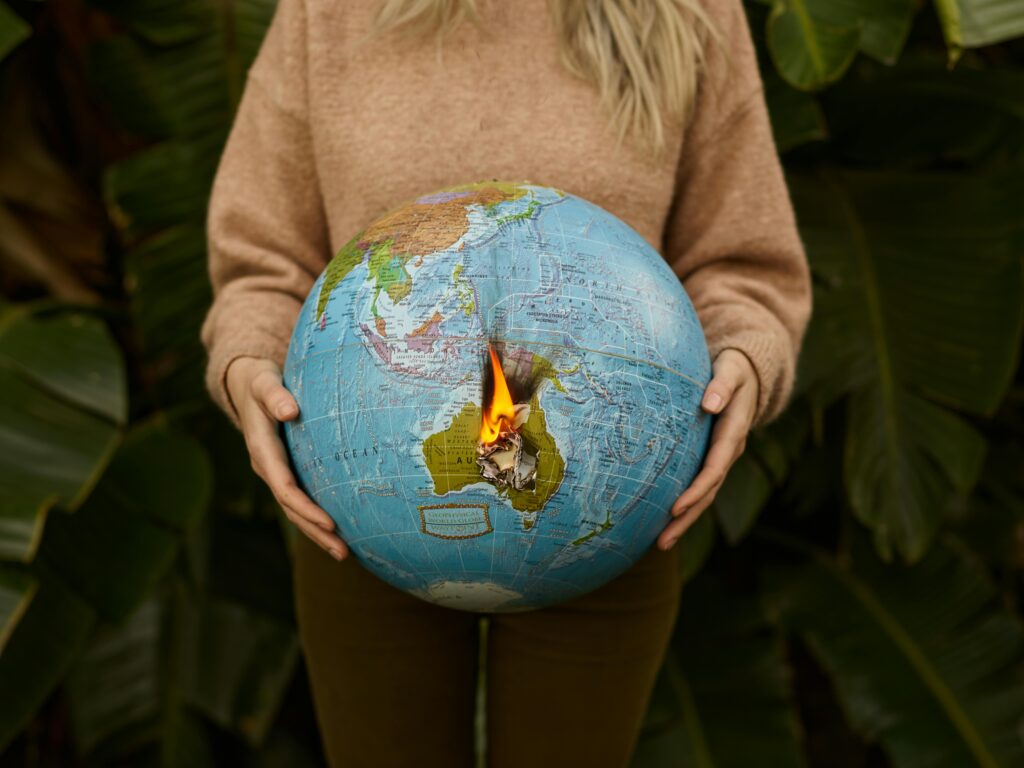
Global warming is the long-term heating of Earth’s climate system. In simple words, our planet is running a fever. Just like your body temperature rises when you’re sick, Earth’s average temperature is rising. Since the late 1800s, the planet has warmed by about 1.2 degrees Celsius. That might sound small. One point two degrees. Hardly noticeable, right? Wrong. For a planet, one degree is enormous. The difference between an ice age and a warm period is only about five or six degrees. So one degree in a century is like a human running a fever that never goes down.
But why is this happening? What’s causing the fever?
Here’s the simple version. The Earth is wrapped in a blanket of gases called the atmosphere. This blanket traps some heat from the sun, keeping the planet warm enough for life to exist. That’s a good thing. Without it, Earth would be a frozen rock. But for the past 150 years, we’ve been thickening that blanket. We’ve been burning coal, oil, and gas. We’ve been cutting down forests. We’ve been raising livestock at massive scales. All of this releases gases into the atmosphere, especially carbon dioxide and methane. These are called greenhouse gases because they trap heat like the glass roof of a greenhouse.
Think of it like this. Your car sitting in the sun with windows rolled up gets hot inside. Sunlight comes in, heat gets trapped, temperature rises. That’s exactly what’s happening to Earth. Sunlight comes in, greenhouse gases trap the heat, and the planet warms up.
Now here’s where it gets serious. This extra heat doesn’t just make summers a little warmer. It changes everything.
The ice at the North and South Poles is melting. Not slowly anymore. Faster than scientists predicted. When ice melts, sea levels rise. And when sea levels rise, coastal cities face flooding. Mumbai, Kolkata, Chennai — all vulnerable. Millions of people living just meters from the ocean.
The weather becomes weird. Not just warm, but weird. Storms get stronger because warmer oceans provide more energy. Rainfall becomes unpredictable. Some places get floods like never before. Others get droughts that last for years. Farmers in India have always depended on the monsoon. But the monsoon doesn’t behave like it used to. It comes late. It goes early. It rains too much in days and then not enough for weeks. For farmers, this means crop failure. For all of us, this means food prices rise.
Heatwaves become more dangerous. In recent years, temperatures in parts of India have touched 50 degrees Celsius. That’s not just uncomfortable. That’s deadly. People die. Especially the poor who don’t have air conditioning or even proper shelter.
The oceans are changing too. They absorb about a quarter of the carbon dioxide we release. That sounds helpful, but it comes with a cost. When CO2 dissolves in seawater, it forms carbonic acid. The ocean becomes more acidic. This harms marine life, especially creatures with shells like corals. Coral reefs are dying worldwide. And coral reefs are like the rainforests of the sea — they support an incredible variety of life. When reefs die, fish populations crash. People who depend on fishing lose their livelihoods.
Now you might be wondering: Is this really happening? Or is it just something people exaggerate?
The evidence is overwhelming. The last decade was the hottest on record. Each of the last four decades has been hotter than any decade since records began. Glaciers in the Himalayas are melting at accelerating rates. These glaciers feed our major rivers — the Ganga, the Yamuna, the Indus. When they disappear, water scarcity becomes a crisis beyond anything we’ve seen.
The science is clear. More than 99 percent of climate scientists agree that humans are causing global warming. That’s not a debate. That’s consensus. In the same way that 99 percent of doctors agree smoking causes cancer.
So what do we do about it?
This is the part where many people feel helpless. The problem feels too big. Too global. What difference can one person make? But here’s the truth: everything big is made of small things. Every journey begins with a single step. Every movement starts with one person choosing to act differently.
There are two things we need to do. First, we need to reduce the amount of greenhouse gases we put into the atmosphere. This is called mitigation. Second, we need to prepare for the changes that are already unavoidable. This is called adaptation.
On mitigation, the big changes need to come from governments and industries. They need to shift from fossil fuels to renewable energy like solar and wind. They need to protect forests and plant new ones. They need to create systems that don’t depend on burning things. But individuals matter too. Every time you choose to walk instead of taking a car, you reduce emissions. Every time you switch off a light, you reduce demand for electricity. Every time you avoid wasting food, you reduce the emissions that went into producing that food. Small actions, multiplied by millions of people, become significant.
On adaptation, we need to build differently. Houses that stay cooler without air conditioning. Crops that can survive droughts. Early warning systems for floods and heatwaves. Water harvesting structures that capture rain when it falls. At Shree Sansthan, we’ve seen how simple things like planting trees around villages can make a difference. Trees provide shade. They cool the air. They hold soil in place during heavy rain. They absorb carbon dioxide. They’re like nature’s own climate solution.
There’s something else we need to talk about. The people who suffer most from global warming are the ones who did the least to cause it. Rich countries have burned fossil fuels for two centuries and become wealthy. Poor countries are now facing the consequences. In India, millions of small farmers, daily wage workers, and coastal communities are on the front lines of a crisis they didn’t create. This isn’t fair. Any solution to global warming has to recognize this injustice and address it.
I think about that old farmer sometimes. His river is gone. His forest is gone. But he still farms. Still hopes. Still plants seeds each year believing they will grow. There’s something profound in that. A faith that even as the world changes, life continues. That we adapt. That we find a way.
Global warming is real. It’s serious. But despair is not a solution. What we need now is clarity about the problem and determination to act. Not fear. Not paralysis. Just clear-eyed understanding and steady effort.
At Shree Sansthan, we plant trees. We teach farmers about climate-resilient crops. We spread awareness through street plays and community meetings. Not because we can solve global warming alone. But because doing something is better than doing nothing. And because every tree planted, every person informed, every small change matters.
The Earth is our home. It’s the only home we have. It’s warming. It’s changing. But it’s not too late to make a difference. Not too late to slow the warming. Not too late to protect the most vulnerable. Not too late to build a world that can survive and thrive.
That farmer still works his land. Still hopes. Still believes in tomorrow.
Maybe that’s the most important lesson of all.
